
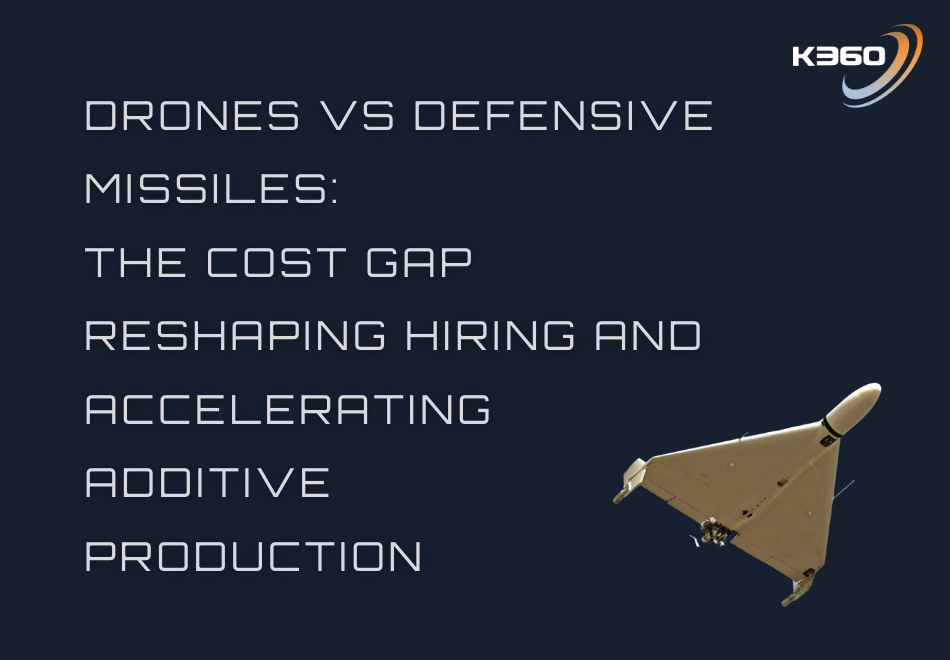
A $500 drone forcing a $4 million missile into the sky isn’t just a battlefield curiosity. It is an industrial policy crisis and a talent emergency. Real world combat from Ukraine to the Red Sea to the Middle East has turned the theoretical ‘cost exchange ratio’ into a brutal daily ledger. If you work in aerospace and defense hiring, supply chain, or advanced manufacturing, understanding that ledger is now a baseline requirement.
1. The Cost Reality: A Snapshot of Unit Prices
The table below consolidates publicly available data from the US Army FY2026 budget justification books, CSIS Missile Defense Project analysis (December 2025 and February/May 2025), JINSA cost estimates from the June 2025 US-Israel-Iran conflict, Norsk Luftvern’s air defense cost database (January 2026), and open source reporting from Defence Express and Defence-blog.com.

A few things stand out. First, the attack side cost floor has collapsed: commodity FPV drones assembled from off the shelf motors, brushless controllers, and 3D printed frames cost roughly what a decent mountain bike costs. Second, even the cheapest Western interceptors cost at least 50 times more than an FPV drone. Third, a new drone-on-drone intercept layer is emerging. Ukraine’s Sting interceptor, at around $2,100, is beginning to close that gap from below.
2. The Cost Exchange Ratio in Plain English
The cost exchange ratio asks a simple question: for every dollar the attacker spends, how many dollars does the defender spend to stop it? In classic air defense, the ratio was roughly 1:1 or better. Intercepting a $1 million cruise missile with a $1 million SAM is economically neutral.
That arithmetic has been smashed. A swarm of Shahed class drones at $20,000–$50,000 each, shot down with PAC-3 MSE interceptors at $3.9 million each, implies a defender cost exchange ratio of around 80:1. The defender burns $80 for every $1 the attacker spends. Even against IRIS-T SLM, the cheapest proven Western medium range interceptor, the ratio sits roughly 8:1 to 20:1 against Shahed class threats. As CSIS noted in its December 2025 analysis, the US Army depleted PAC-3 MSE stocks to just 25% of the minimum required threshold by mid 2025, driven in part by the unprecedented expenditure of interceptors during the June 2025 US-Israel-Iran conflict.
This matters for two reasons beyond battlefield tactics. First, defenders cannot sustain indefinite high cost engagement against low cost mass attack. Magazine depth is finite and production lead times run 34–36 months for PAC-3 MSE. Second, the economics are pushing both attackers and defenders toward new solutions: cheaper interceptors, directed energy, and critically, higher rate production of everything.
3. What Changes for the Industrial Base
The cost imbalance is driving a structural shift in how Western defense primes and their supply chains think about production. Three forces are colliding simultaneously.
High volume, high rate production is back. Lockheed Martin has a stated target of tripling PAC-3 MSE output to 2,000 per year. Diehl Defence is scaling IRIS-T missile production to 400–500 per year. These are not peacetime modernisation programmes. They are surge orders placed under active wartime consumption pressure. For manufacturers, this means relearning how to run hot production lines, something most Western primes have not done in a generation.
COTS vs mil spec is no longer a philosophical debate. The Shahed’s strategic advantage is its use of commodity components: mass market microcontrollers, commercial GPS antennas, and standardised engines. Western drone programmes are adopting the same playbook. Anduril’s Bolt-M, at around $20,000–$40,000, shows that even AI enabled FPV drones can be built with predominantly commercial components at acceptable performance levels. For supply chain teams, that means sourcing from non traditional, non-ITAR, commercial electronics channels, which marks a significant departure from decades of mil spec procurement culture.
Chokepoints are real and getting worse. Four components are bottlenecking both offensive UAS and interceptor production: brushless electric motors (currently dominated by Chinese manufacturers), lithium battery cells, electro-optical/IR sensors, and radiation hardened or EW resistant chips. DoD’s Replicator 2 initiative, stood up in 2025 to defend installations from drone threats, has already identified domestic motor and battery manufacturing as critical gaps. Supply chain professionals who can navigate both commercial semiconductor markets and ITAR compliant mil spec channels are in rare supply.
4. Recruitment Impact: Where the Talent Demand Is Heading
Based on DoD’s December 2024 Counter UAS strategy, the FY2026 C-UAS budget allocation of $3.1 billion, the Army’s establishment of Joint Interagency Task Force 401 for counter UAS in August 2025, and the broader industrial base surge, here are the role areas and disciplines seeing the steepest upward demand curve right now.
Roles and Skill Areas in Rising Demand
• Electronic Warfare (EW) / RF Engineers: The arms race between drone navigation and jamming is accelerating on both sides. Fibre optic guided FPVs are defeating RF based EW, forcing second order innovations in counter EW. Demand for engineers who can design, test, and certify EW systems has roughly doubled at most Tier 1 primes since 2023.
• Autonomy / Perception Engineers (AI/ML on embedded platforms): Guidance, target acquisition, and terminal phase navigation all require real time inference on constrained hardware. Roles combining computer vision, YOLO class neural networks, and embedded deployment (TensorRT, OpenVINO) are extremely scarce.
• Guidance, Navigation & Control (GNC) Engineers: Across both offensive UAS and interceptors, GNC specialists, particularly those comfortable with INS/GNSS integration and GPS denied environments, are among the hardest A&D hires in the market.
• Embedded / Firmware Engineers (safety critical): Real time operating systems, DO-178C or MIL-STD-882E compliance, and deterministic latency requirements on SWaP constrained hardware. The talent pool is thin and clearance requirements shrink it further.
• Power Electronics Engineers: High efficiency motor drives, battery management systems, and thermal management for high cycle rate launchers and drone propulsion. A discipline that has historically lived in the EV and industrial automation worlds and is now in heavy demand in defence.
• Production / Manufacturing Engineers (high rate): Setting up and optimising assembly lines for hundreds to thousands of munitions per month, covering lean manufacturing, process FMEA, and line rate tooling design. Talent that understands both consumer electronics manufacturing speed and defence grade quality requirements is vanishingly rare.
• Quality Assurance / Quality Engineers (advanced manufacturing): AS9100-rev-D, NADCAP, and functional safety qualification for 3D printed and hybrid manufactured components. AM specific QA is an emerging specialism with very few trained practitioners.
• Supply Chain / Procurement Professionals (dual use components): Managing bill of materials that blend COTS commercial electronics with export controlled subsystems. Understanding the ITAR/EAR boundary, building domestic motor and battery supply alternatives, and managing surge capacity contracts.
• Test & Evaluation (T&E) Engineers: Hardware-in-the-loop and software-in-the-loop testing for autonomous systems, EW signature assessment, and high rate production acceptance testing. DoD has directed a dedicated C-UAS T&E range be established within 30 days (August 2025 directive).
• Cost Engineers / Should Cost Analysts: As programmes shift from cost plus to fixed price and OTAs, accurate should cost modelling for high volume drone and munitions production is becoming a strategic asset at primes and programme offices.
5. Additive Manufacturing: Where It Helps and Where It Doesn’t
The DoD allocated roughly $800 million for additive manufacturing in FY2024, a 166% increase on the prior year, with projections of $2.6 billion by FY2030 (AM Research / DoD budget data). That money is well targeted in some areas and likely to disappoint in others.
Where AM Delivers Now
• Rapid tooling and jigs: 3D printed fixtures, assembly jigs, and test adapters cut tooling lead times from weeks to days on new drone variants. The value here is speed, not part cost.
• Ducting, mounts, and housings: Complex non structural geometries such as air intake ducts, sensor mounts, and avionics bays that previously required multi part fabrication can now be produced as single piece prints. Weight savings often exceed 20%.
• Brackets and secondary structure: Low volume, geometrically complex brackets for new UAS airframe variants are a natural fit for powder bed fusion or FDM. Break even versus CNC typically occurs below 500 units.
• Thermal management components: Conformal cooling inserts for electronics bays and heat spreaders with complex internal geometries are difficult to machine but straightforward to print in copper or aluminium alloy.
• Spares and legacy parts on demand: Field level printing of non structural spares for aging systems (vehicle components, connector housings, environmental covers) is already operational across US Army depots and the UK MOD’s Project TAMPA.
• Surge capacity and bridge production: When conventional manufacturing lines are at capacity, AM can supply limited quantities of airframe sections, warhead components, and structural parts while tooling is being commissioned for higher rate production.
Where AM Is Unlikely to Win on Cost at Scale
A senior Boeing AM leader, quoted in War on the Rocks, summarised the boundary clearly: ‘additive excels for complex geometries and consolidated assemblies but becomes more expensive and carries negative trades for ‘simple parts such as brackets or castings’ at volume.’ Injection moulding beats FDM on unit cost above a few thousand parts per year. CNC machining is faster and cheaper for simple metal brackets. High cycle rate munition bodies requiring tight tolerances on external aerodynamic surfaces are better served by cold form or investment casting at the volumes defence now requires. The argument for AM is speed and flexibility, not steady state cost at tens of thousands of units.
The Bridge Strategy
The practical approach that leading defence manufacturers are adopting, and that hiring managers should understand when evaluating AM talent, is a deliberate phased architecture. In Phase 1 (prototype and early ramp), AM produces all structural variants to accelerate design iteration and generate early qualification data. In Phase 2 (bridge production), AM supplies components in parallel with conventional tooling development, maintaining supply chain continuity during the 6–18 month tooling lead time. In Phase 3 (volume production), the programme transitions primary production to conventional manufacturing, namely injection moulding, casting, and CNC, while AM is retained for customisation, low volume variants, field spares, and next generation design iteration. Firestorm Labs (backed by $147 million including a $100 million US Air Force contract) has structured its shipping container AM factories precisely this way: not to replace conventional manufacturing, but to get to the field first and hold the supply chain hostage to volume until conventional lines are ready.
The Bottom Line for Hirers
The cost gap between a $500 FPV drone and a $4 million interceptor is not closing quickly enough through interceptor price reductions alone. The industrial response, which means more volume, faster iteration, modularity, and AM assisted production ramp, requires a specific type of talent: engineers who can work at the intersection of commercial product speed and defence grade reliability. That combination is genuinely scarce, and the competition for it is intensifying across both established primes and the rapidly growing tier of venture backed defence startups.