
One New Technician for Every Seven Labs: Why the UK Dental Lab Workforce Needs a Rethink
143 dental technicians joined the UK register in 2025. The Dental Laboratories Association Ltd has around 1,000 members, whose labs are estimated to be responsible for more than 80% of dental laboratory services in the UK. Put those two numbers next to each other and the issue becomes very hard to ignore.
That is roughly one new dental technician for every seven DLA member labs. It is not a perfect like-for-like comparison, because one figure is new registrants and the other is member laboratories, but it does show how thin the replenishment rate has become against the size of the sector.
For anyone running a dental lab, that should be a genuine concern. Not because it makes for a dramatic headline, but because it points to something much bigger than a simple recruitment challenge.
This is a capacity problem, a quality problem, a succession problem and, increasingly, a digital skills problem. Dental labs are being asked to deliver more complex work, faster, with higher expectations from clinicians and patients. Crowns, bridges, dentures, implant work, ceramics, CAD/CAM, milling and 3D printing are all part of a more demanding production environment, but the skilled workforce behind that work is getting smaller.
That is the part the industry needs to take seriously. Digital dentistry has not made dental technicians less important. If anything, it has made the good ones harder to find, harder to replace and far more valuable.
The decline is structural, not cyclical
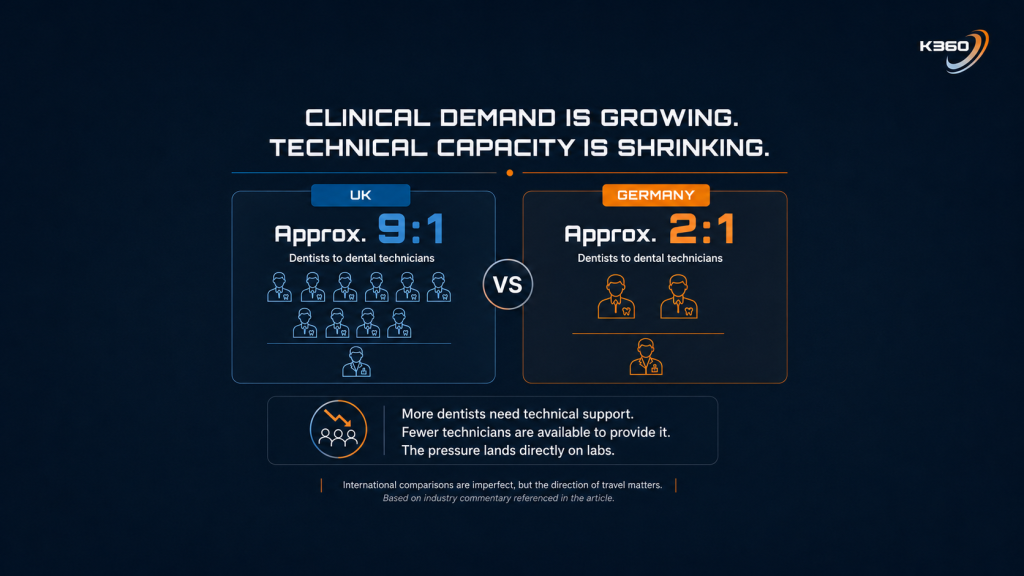
The dentist workforce has continued to grow, but the technician workforce has been moving in the opposite direction. That gap matters because every dentist still relies on the technical work behind the restoration, appliance or case being done properly. When the clinical side grows but the technical workforce shrinks, the pressure lands directly on labs.
To put that imbalance into context, industry commentary has compared the UK with Germany, where the ratio of dentists to dental technicians is reported to be around 2:1. In the UK, that figure is now closer to 9:1. It is not a perfect international comparison, because every country structures dental care and laboratory work differently, but the direction of travel is hard to ignore. The UK has more dentists needing technical support, fewer registered technicians providing it, and a widening gap between clinical demand and laboratory capacity.
The risk is not just whether a lab can fill a vacancy today. It is whether there are enough skilled technicians coming through to support the level of work labs will need to deliver over the next five to ten years. A lot of the most experienced people in the market are now at the later stages of their careers. Senior technicians are retiring, stepping back or simply getting worn down by the pressure.
Behind them, the replacement pool is thin. That creates a simple but uncomfortable question for lab owners: who is doing this work in five years’ time?
Digitisation should not mean leaving experienced technicians behind
Some of the most valuable people in this industry are the experienced technicians who have spent decades building judgement by hand. Senior ceramists, prosthetics specialists, crown and bridge technicians and removables technicians carry knowledge that cannot be downloaded into a machine or replaced by software training. They understand fit, function, aesthetics, materials and the small details that make the difference between work that is acceptable and work that is genuinely good.
The challenge is not choosing between tradition and technology. It is making sure the two can work together. In some labs, that means embracing digital workflows more quickly. In others, it means protecting traditional skills and making sure experienced technicians are given a realistic route to stay in the game, adapt where needed and pass their knowledge on before it disappears.
That part matters. If older technicians feel like digitisation is something being done to them rather than with them, the industry risks losing people it cannot afford to lose. But if labs involve them properly, support them with training and use their judgement to shape digital workflows, they can become some of the most important people in that transition.
At the same time, new dental technicians need room to flourish. They should not be brought into the profession just to sit on repetitive tasks with no exposure, no progression and no real development. They need access to the craft, the technology and the experienced people who can help them understand both.
The best future labs will be the ones that create that bridge: experienced technicians passing on judgement, younger technicians bringing energy and digital confidence, and both sides learning from each other.
That is how the industry moves forward without losing what made it valuable in the first place.
The market has split
From the conversations I am having with labs, the market feels like it has split into two. Larger groups and better-funded labs are investing in digital production infrastructure and need hybrid technicians who can work across CAD/CAM, milling, printing, quality control and production workflows. Smaller and more traditional labs are still heavily dependent on experienced hands-on technicians across ceramics, crown and bridge, prosthetics and removables.
Both are struggling to hire, but for different reasons. The larger labs need people who can bring clinical understanding into a digital workflow. The smaller labs need experienced technicians who can still do the work, manage complex cases and support less experienced people around them.
Their challenge is not always digital upskilling. Sometimes it is much more basic than that. It is that the technicians they have relied on for years are leaving, and there is nobody obvious coming through to replace them.
The underlying issue is the same across both sides of the market. There are not enough skilled technicians available for the level of demand.
Training needs to become a bigger part of the answer
Recruitment alone will not fix this. The training route into dental technology still exists, and there are colleges, apprenticeship providers and employers doing good work, but the output is nowhere near enough to replace the people leaving the profession, fill the digital skills gap and support the level of demand coming from labs.
The overseas hiring route has also become harder to rely on following changes to Skilled Worker visa eligibility in 2025. Dental technicians sit under SOC 3213, which is classed as a medium-skilled occupation for Skilled Worker purposes. Following the July 2025 changes, sponsorship is more limited for most new applicants than it was previously. That does not mean international hiring is impossible in every scenario, but it does mean labs need to be more realistic about what their long-term staffing strategy looks like.
A thin domestic pipeline and a more difficult immigration route are hitting the market at exactly the wrong time. Demand is not slowing down. Complexity is not going away. Digital expectations are not going backwards.
So the question becomes: how do labs build, develop and keep more of their own talent?
This is already showing up inside labs
For lab owners and operations managers, this is not just an industry talking point. It shows up in the numbers that matter most.
It shows up when turnaround times slip because a key technician leaves. It shows up when remake rates increase because less experienced people are taking on complex work without enough support. It shows up when a lab cannot take on more implant or full-arch work because the capability is not there internally.
It also shows up in overtime, outsourcing and succession risk. It shows up when a senior ceramist or prosthetics lead is close to retirement and there is nobody obvious being developed behind them.
That is the real risk. Not that technology replaces technicians, but that the industry does not produce enough technicians for the version of the role that now exists. The future dental lab is not going to be less dependent on people. It is going to be more dependent on a smaller number of highly capable people.
Young technicians need a reason to stay
There is also a bigger conversation to be had around young technicians. Dental technology should be an attractive career. It sits between precision manufacturing, digital design, materials science and clinical work. It is hands-on, technical, creative and increasingly technology-led. For the right person, that should be a brilliant career path.
The problem is that the profession has a visibility issue, and in too many labs it also has a development issue. If a young technician comes into a lab and spends the first few years doing repetitive work with no clear pathway, no exposure to different departments and no real investment, it is not surprising when they leave.
That is how the industry loses future senior technicians before they ever get there. New technicians need to be allowed to flourish, not just fill gaps in production. They need to see a future for themselves in the profession. That means proper mentoring, exposure to different types of work, digital training where it adds value and access to experienced technicians who can pass on the judgement that only comes from years at the bench.
The labs that get this right tend to do a few things well. They expose junior technicians to different parts of the lab, pair them with experienced people who can actually teach the craft, invest in digital training early and show people what progression looks like.
They do not treat younger technicians as cheap labour, and they do not treat experienced technicians as outdated. They create a proper exchange between the two.
That matters because every apprentice or junior technician who stays, develops and eventually becomes a senior technician or department lead is a return on investment. Every experienced technician who stays engaged long enough to pass on their skills is also a return on investment.
What labs need to do now
Labs need to stop treating this as just a hiring problem. It needs to be a retention, training, succession and upskilling problem as well.
That means protecting experienced technicians and making sure their knowledge is passed on properly. Senior ceramists, crown and bridge specialists, prosthetics leads and removables technicians carry embedded knowledge that cannot be replaced quickly. Structured knowledge transfer and genuine career recognition for experienced practitioners are not soft HR gestures. They are commercial risk management.
It means building trainee pathways rather than waiting for the market to produce perfect candidates. Labs that develop their own pipeline are less exposed to market shortages than those that only hire externally.
It means upskilling across the digital divide. A technician with strong crown and bridge, ceramics or prosthetics foundations can be an excellent candidate for 3Shape or exocad training. The clinical knowledge is already there. The digital layer can be taught. Investing in that transition builds some of the most valuable hybrid talent in the market.
It means creating proper progression routes from trainee to technician, technician to senior, senior to department lead and department lead to lab manager. People leave when there is no clear path forward. Progression retains people and builds the leadership pipeline labs will need.
Just as importantly, it means being more realistic with hiring. Waiting for the perfect candidate with ten years of technical experience, strong digital workflow knowledge, the right materials background and immediate availability is not a strategy.
In this market, labs need to hire for strong foundations, attitude and technical judgement, then invest properly in the rest.
The labs that win will not just be the ones with the best equipment. They will be the ones that build the strongest teams around it.
Final thought
The dental lab workforce crisis is not something coming down the road. It is already here. The technology will keep moving, the work will keep getting more complex, and clinician and patient expectations will keep rising. But none of it works without skilled technicians behind it.
At Kensington360, dental technology is a market I work in closely across the UK. The conversations I have with lab owners and production managers are increasingly the same: how do we find, develop and hold on to people who understand both the craft and the technology?
That is the real challenge, and for the labs that get it right, it is also the opportunity.
If you are thinking about your technician talent strategy, whether that is a live hire, succession planning for a senior ceramist or department lead, or building a team across CAD/CAM, milling and digital production, I would welcome a conversation.
Sources referenced: GDC 2025 Registration Statistical Report, Dental Laboratories Association, Dentistry.co.uk workforce commentary and GOV.UK Skilled Worker occupation guidance.