
Additive Manufacturing in 2027: The Trends, Technologies and Talent Shaping the Future
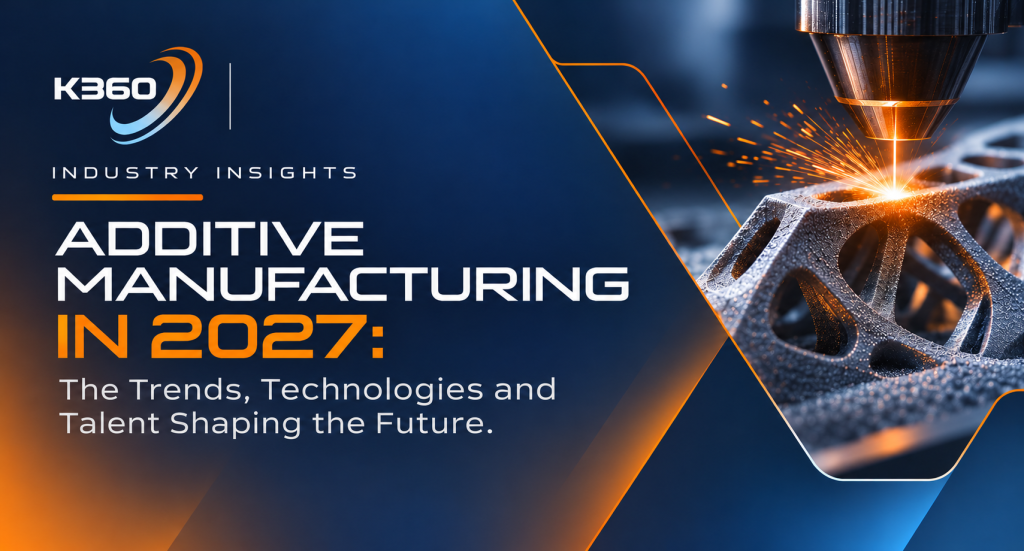
Where is the industry heading, which additive manufacturing trends are driving the next wave of growth, and what will they mean for the businesses and people shaping the sector?
Additive manufacturing has come a long way from its early days of prototyping and proof-of-concept projects. Today, it’s an increasingly important part of the wider manufacturing landscape, with applications spanning aerospace, defence, energy, medical and beyond.
But as we head into 2027, the conversation is changing. It’s no longer just about what the technology can do. It’s about making it work commercially, scaling production, improving efficiency and finding the right people to turn innovation into real-world results.
From artificial intelligence and automation to materials development and the growing demand for specialist talent, there are plenty of developments worth keeping an eye on.
We’ve explored nine additive manufacturing trends we believe will have a significant influence on the industry over the coming year.
1. From experimentation to commercial production
One of the biggest shifts in additive manufacturing is the move away from experimentation and towards genuine, commercially viable production.
For years, the focus has often been on what the technology is capable of producing. Now, manufacturers are asking a different question: how can we make it work at scale, and does it make financial sense?
Investment decisions are becoming more closely linked to productivity, machine utilisation and return on investment. Businesses want to see tangible benefits, whether that’s reducing lead times, improving component performance, lowering material waste or simplifying production.
The Wohlers Report 2026, published by Wohlers Associates in partnership with ASTM International, valued the global additive manufacturing market at $24.2 billion in 2025, representing annual growth of 10.9%.
Interestingly, manufacturing services accounted for 48% of global revenue, compared with 26% from system sales and servicing. AM services also grew by 15.5%, significantly outperforming system sales.
This points towards an industry increasingly focused on what additive manufacturing can deliver, rather than simply the equipment behind it.
Our take: The businesses that succeed will be those that can make additive manufacturing work commercially, not just technically. Being able to demonstrate a clear return on investment will be increasingly important when securing new customers and justifying further investment.
2. Aerospace, defence and space continue to drive demand
Aerospace, defence and space are likely to remain some of the biggest opportunities for additive manufacturing in 2027.
It’s easy to see why. These industries are constantly looking for ways to reduce weight, improve performance, produce increasingly complex components and make supply chains more resilient. Additive manufacturing offers solutions to many of these challenges.
In aerospace, even relatively small weight reductions can deliver significant benefits over the lifetime of an aircraft. In defence, the ability to manufacture specialist replacement parts, support drone development and reduce reliance on lengthy supply chains is becoming increasingly valuable.
Defence is particularly interesting at the moment.
An October 2026 industry analysis published by Formnext, drawing on research from AMPOWER and other industry organisations, highlighted strong demand across defence and space. AMPOWER reported annual growth of more than 20% in defence and space equipment sales over the preceding four years, with further annual growth of close to 19% forecast through to 2030.
Applications range from replacement components for legacy equipment and drone technologies to rocket propulsion and more localised manufacturing capabilities.
Our take: These sectors offer significant opportunities, but technical capability alone isn’t enough. Manufacturers need people who understand the complexities of aerospace and defence, including quality, reliability, certification and the demands of producing safety-critical components.
3. Artificial intelligence and smarter manufacturing
AI is everywhere at the moment, and additive manufacturing is no exception. While we’re still at an evolving stage of adoption, its potential to improve manufacturing processes is significant.
One of the biggest opportunities is making production more predictable, efficient and consistent.
AI-powered software and machine learning can analyse production data, identify patterns, flag potential defects and help manufacturers optimise printing parameters.
Some of the most interesting applications include:
- Generative design: Creating component geometries that optimise strength, weight and material consumption.
- Predictive maintenance: Identifying potential equipment failures before they cause costly downtime.
- Process monitoring: Spotting inconsistencies during production and helping prevent defects.
- Quality assurance: Improving inspection processes and production reliability.
- Digital twins: Creating virtual models of machines and components to test, simulate and optimise performance.
Skills England’s October 2026 advanced manufacturing assessment also highlights the growing integration of AI across planning, quality control, supply chains and predictive maintenance.
For additive manufacturing, the opportunities are particularly interesting given the volume of data generated throughout the production process.
Of course, adopting AI isn’t simply a case of introducing new software. Businesses will need reliable data, systems that work together and people who know how to interpret and apply the information.
Our take: The combination of engineering expertise and digital capability will become increasingly valuable. We expect to see growing demand for professionals who understand both additive manufacturing and the software, data and automation technologies supporting it.
4. Automation and scaling production
As additive manufacturing becomes more commercially established, automation will become an increasingly important part of the conversation.
Printing technology has advanced considerably, but the processes surrounding production can still be time-consuming and expensive. Powder handling, component removal, support removal, heat treatment, finishing and inspection all have an impact on the overall cost and efficiency of manufacturing.
That’s where automation comes in.
Manufacturers are looking at ways to connect more of these processes, reducing manual intervention and creating smoother, more efficient production environments.
This includes robotic post-processing, automated material handling, integrated production planning and automated inspection.
The benefits go beyond reducing costs. Automation can improve consistency, increase machine utilisation, support workplace safety and help businesses manage ongoing skills shortages.
Our take: The opportunity isn’t just about developing better printers. It’s about improving everything that happens before, during and after the printing process. Automation, robotics and manufacturing engineering expertise will be central to making additive production more scalable.
5. Materials innovation and the expansion of metal AM
The development of new materials remains one of the most important factors in unlocking further applications for additive manufacturing.
In metal AM, continued developments in titanium alloys, nickel-based superalloys, aluminium, copper and advanced steels are helping manufacturers meet increasingly demanding performance requirements.
This is particularly relevant across aerospace, energy, automotive and medical manufacturing, where material properties can make or break an application.
Another area worth watching is Directed Energy Deposition (DED).
Unlike powder bed fusion, DED deposits material directly into a melt pool, making it particularly useful for larger components, repair work and hybrid manufacturing processes.
Formnext’s October 2026 industry analysis highlighted energy as an emerging opportunity for DED, particularly in applications such as gas turbines. It also identified growing interest in investment across materials and feedstock.
And it’s not just metals. Polymer additive manufacturing will continue to evolve, particularly where specialist materials and functional end-use components offer a genuine advantage.
Our take: Materials innovation is about much more than finding something new to print with. It’s about opening up applications that weren’t previously possible or commercially viable. Materials scientists, metallurgists and process development specialists will remain incredibly important to that progress.
6. Qualification, certification and quality assurance
As additive manufacturing moves further into safety-critical and regulated industries, getting the technology right is only half the battle. Manufacturers also need to prove that they can produce components consistently, reliably and to the required standards.
This is particularly important across aerospace, defence, medical and energy, where there is very little room for error.
Qualification and certification involve much more than inspecting the finished component. They require control and traceability throughout the manufacturing process, from material selection and machine calibration through to post-processing and final testing.
The 2026 ANSI and America Makes standards progress report highlighted continued developments in material qualification, process monitoring, heat treatment, inspection and certification.
Technologies such as X-ray computed tomography and ultrasonic inspection are also becoming increasingly important in identifying defects and verifying component integrity.
As more manufacturers look to move additive manufacturing into established production environments, these processes will become even more important.
Our take: Quality and certification shouldn’t be treated as an afterthought. Businesses looking to scale will need experienced specialists who understand the technical and regulatory requirements involved in producing components for demanding applications.
7. More accessible technology and lower-cost production
Not every manufacturing application needs the most advanced, expensive industrial printer. That’s becoming increasingly clear as lower-cost additive manufacturing technology continues to develop.
Improvements in desktop and prosumer-level polymer printing are creating new opportunities for businesses that previously may have found the initial investment difficult to justify.
Formnext’s October 2026 analysis highlighted AMPOWER findings that desktop polymer equipment priced below €10,000 was growing at more than 30% annually, compared with approximately 6–8% for industrial equipment.
Some manufacturers are also using networks of lower-cost printers, or print farms, to fulfil production requirements where industrial-grade equipment isn’t necessary.
Of course, this doesn’t mean specialist industrial systems are going anywhere. High-performance metal applications, demanding tolerances and certified production will continue to require sophisticated equipment.
However, it does demonstrate that the market is becoming more diverse, with different technologies offering different commercial advantages.
Our take: Greater accessibility could bring more businesses into the additive manufacturing space, particularly SMEs. The real opportunity will be understanding which technology is right for each application, rather than assuming bigger investment always means better results.
8. Sustainability and supply chain resilience
Sustainability remains an important part of the additive manufacturing conversation, but the focus is becoming more commercially driven.
Manufacturers are increasingly looking at how additive manufacturing can help reduce material waste, improve resource efficiency and make supply chains more resilient.
The ability to produce replacement components closer to where they’re needed could be particularly valuable for industries dealing with complex supply chains, specialist parts and long lead times.
For aerospace, defence, energy and heavy industry, this could reduce reliance on overseas suppliers and the need to hold large inventories of physical components.
There are, of course, considerations around energy consumption, material production, powder handling and post-processing. Additive manufacturing isn’t automatically the more sustainable option in every application.
The real opportunity lies in understanding where it offers genuine environmental and commercial benefits.
Our take: Sustainability is increasingly becoming a business consideration rather than simply a marketing message. Manufacturers that can demonstrate improvements in resource efficiency, component lifecycle and supply chain resilience will be better positioned as expectations continue to evolve.
9. The talent challenge: finding the people to deliver growth
We can talk about technology, materials and investment all day, but ultimately, it’s people who will determine how successfully the industry moves forward.
As additive manufacturing develops, businesses need professionals who can combine traditional engineering knowledge with an increasingly sophisticated understanding of digital manufacturing, materials science, software and automation.
And finding those people isn’t necessarily straightforward.
Skills England’s October 2026 assessment estimates that priority occupations within advanced manufacturing will require approximately 148,000 workers between 2025 and 2035. This includes 47,000 additional workers to support employment growth and 101,000 replacements for people leaving these occupations.
For additive manufacturing businesses, some of the most important skill areas are likely to include:
| Skill area | Relevant roles |
|---|---|
| Metal AM and process development | Additive Manufacturing Engineers, Process Development Engineers |
| Materials science | Materials Scientists, Metallurgists |
| Digital manufacturing | Software Engineers, Simulation Engineers, Data Specialists |
| Automation and robotics | Automation Engineers, Robotics Engineers |
| Quality and certification | Quality Managers, NDT Specialists |
| Production and operations | Manufacturing Engineers, Production Managers |
| Commercial leadership | Technical Directors, Engineering Directors |
We’re also likely to see greater demand for people who can bridge the gap between technical innovation and commercial implementation.
As the industry matures, businesses won’t just need engineers who understand how to operate additive manufacturing equipment. They’ll need people who can identify viable applications, lead technology integration, manage multidisciplinary teams and translate technical capabilities into commercial results.
For employers, this means thinking carefully about how they attract and retain talent. Competitive salaries matter, but so do career development, investment in technology and the opportunity to work on genuinely interesting projects.
Our take: Access to specialist talent could become one of the biggest competitive differentiators in additive manufacturing. The businesses that recognise this early and invest in building the right teams will be in a much stronger position to take advantage of the opportunities ahead.
Looking ahead: the additive manufacturing trends that will define 2027
There’s plenty to be positive about as we look towards 2027. Additive manufacturing is becoming more commercially established, investment is evolving and the range of potential applications continues to grow.
Aerospace, defence and space will remain important drivers, while energy, medical and industrial applications offer further opportunities. AI, automation and materials innovation will continue to push the technology forward, with quality, qualification and certification helping to support wider adoption.
But perhaps the biggest takeaway is that technology alone won’t determine the industry’s success.
The next phase of growth will depend on having the right people, the right processes and the right commercial strategy in place.
For manufacturers, that means looking beyond the technology itself and considering how they build the capabilities and teams needed to make the most of it.
The future of additive manufacturing isn’t just about what we can manufacture. It’s about what we can achieve when the right technology, expertise and people come together.
Building a team ready for the additive manufacturing trends of 2027? Find out more about our additive manufacturing recruitment services, hire specialist talent or browse our latest vacancies.
Sources and further reading
- Wohlers Associates / ASTM International – Wohlers Report 2026: Global market performance and industry growth.
- Formnext – Industrial AM regains momentum (October 2026): Industry sentiment, defence, energy, materials and production trends.
- Skills England – Sector Skills Needs Assessment: Advanced Manufacturing (October 2026): UK workforce projections and skills requirements.
- ANSI / America Makes – Additive Manufacturing Standards Progress Report (2026): Qualification, certification and inspection.
- AMT – AM’s Measured Growth Signals a More Mature Industry (August 2026): Commercial adoption and end-use applications.
- AMUK – Annual Plan 2026: UK additive manufacturing opportunities.
- European Additive Manufacturing Skills Strategy Roadmap (2026): Skills gaps and workforce development.