
How Many 3D Printed Parts are on Artemis II?
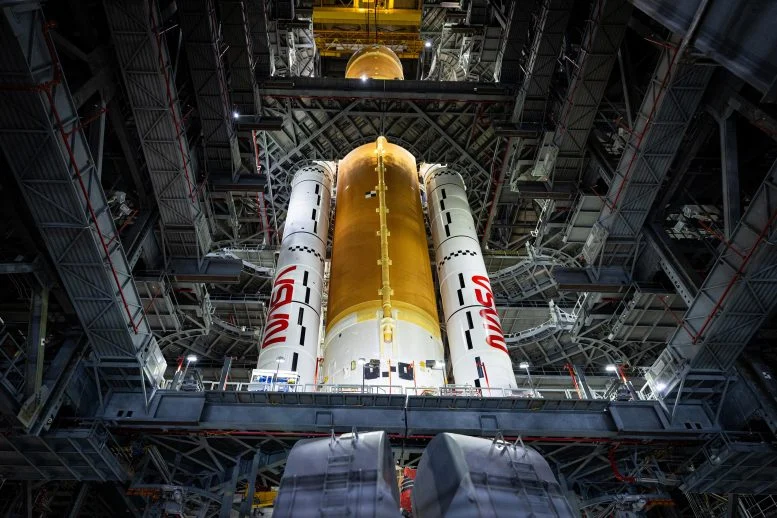
Artemis II has sent four astronauts further from Earth than any human has travelled since the Apollo programme. But here is what most people outside the industry do not know: a meaningful number of the parts keeping that crew safe were built layer by layer, on a 3D printer. So exactly how many? The honest answer is that a complete official part-by-part list has never been made public. What is documented, however, tells a compelling story about where additive manufacturing sits in the most demanding engineering environment imaginable.
The Numbers We Can Confirm
The vast majority of confirmed AM flight hardware on Artemis II sits on the Orion spacecraft, not on the Space Launch System rocket itself. Here is what public disclosures from NASA, Lockheed Martin, Aerojet Rocketdyne, and Stratasys allow us to state with confidence.
- 150+Polymer AM production parts on the Orion spacecraft.
- 12 Metal AM RCS thruster nozzle extensions on Orion’s crew module.
- It took less than three weeks to produce all 12 nozzle extensions on a single AM machine.
Those 150+ polymer parts include brackets, covers, ducting components, and a standout piece: the external docking hatch cover and ring, a six-piece assembly roughly one metre in diameter. It was printed using a PEKK-based electrostatic-dissipative (ESD) material, specifically chosen to manage electrostatic risk in the space environment without the need for secondary coatings or nickel plating. Stratasys supplied the materials and printing systems; Lockheed Martin’s own AM facility built the parts.
The 12 RCS thruster nozzle extensions are a different proposition entirely. These are metal AM components on attitude control thrusters that directly influence re-entry orientation and crew safety. According to public reporting from the propulsion supplier, all 12 were produced on a single AM machine in approximately three weeks, roughly 40% faster than conventional manufacturing methods.
“AM qualification is not just printing. It is the controlled combination of build, post-processing, machining, coupons, inspection, and flight feedback.”
A Snapshot of the Key Parts
| Part | Type | Key Detail | Why It Matters |
|---|---|---|---|
| Docking hatch cover / ring | Polymer | ~1 m diameter, 6 pieces, PEKK-based ESD material, FDM process | Eliminates secondary ESD coatings; flagship large-format AM part on Orion |
| 150+ production polymer parts | Polymer | ULTEM 9085 and Antero family materials; brackets, covers, ducts | Demonstrates AM at production scale on a human-rated spacecraft |
| RCS thruster nozzle extensions (x12) | 12 units, single AM machine, ~3 weeks, ~40% faster than conventional | Metal AM on crew-critical propulsion hardware with full qualification testing | |
| Inconel 718 vent assemblies (EFT-1) | 4 parts, HIP + heat treatment post-processing, tested to ASTM F3055 | Earliest public record of a fully documented AM qualification pathway for Orion |
What About the Rocket?
The Space Launch System itself tells a slightly different story. The heritage RS-25 engines used for the first four Artemis missions were originally built for the Space Shuttle; the strongest AM evidence relates to new-production engines being prepared for Artemis V and beyond.
NASA has publicly reported that a 3D-printed pogo accumulator assembly, manufactured using selective laser melting, was hot-fire tested as part of the RS-25 modernisation programme. The results were significant: over 100 welds eliminated, production time reduced by more than 80%, and costs reduced by approximately 35% for that component. A development test series also introduced 3D-printed valves and rigid ducts into the engine, with NASA confirming that around half of the new printed components were validated in that series, with the remainder tested separately.
For context on where propulsion AM is heading: in late 2023 and early 2024, a metal AM Orion Main Engine injector was successfully hot-fire tested at White Sands across 21 firing runs, with further engine-level testing planned. This is AM penetrating the heart of a rocket engine, not just the brackets around it.
Why Qualification Is the Real Story
Here is what we find genuinely striking from a talent and industry perspective: the parts themselves are only part of the narrative. The harder challenge, and the one that creates lasting competitive advantage, is the qualification process that sits behind them.
The most detailed public record of AM qualification on Orion comes from the Exploration Flight Test 1 mission in December 2014. Four Inconel 718 vent assemblies flew on that vehicle, and what was documented afterward is instructive. Post-processing included stress relief, hot isostatic pressing, solution treatment, and ageing. Mechanical testing followed ASTM standards. Microstructural evaluation checked for porosity and confirmed the absence of unwanted Laves phase, a known risk in nickel superalloy AM. Post-flight inspection found no defects.
That level of rigour, build plus post-processing plus coupons plus NDE plus flight feedback, is what human-rated AM looks like. It is also what defence procurement increasingly requires, and what makes Artemis-era examples directly relevant to anyone sourcing AM engineers and programme leads for defence contracts.
The Talent Angle
From where we sit as recruiters, this is what the Artemis II picture tells us about the people businesses need right now.
What Artemis II Signals for AM Hiring
- Demand for AM engineers who understand qualification, not just printing. Process specs, NDE, material allowables, and test evidence are the core skill set, not the machine itself.
- Polymer AM at production scale requires configuration control and repeatability expertise, not just design freedom. Orion’s 150+ parts were built inside a quality-managed facility, not a lab.
- Metal AM in propulsion means post-processing knowledge is non-negotiable. HIP, heat treatment, and microstructural evaluation sit alongside build expertise.
- The digital thread, traceability, ITAR compliance, and quality management systems(AS9100), is becoming as important as the engineering in defence-facing AM roles.
- Lead time and cost reduction are the commercial arguments that move programmes. The people who can quantify and communicate that ROI are increasingly valuable at the senior level.
The Bottom Line
No official public list accounts for every 3D printed part on Artemis II, and given the controlled nature of flight qualification data, that is unlikely to change. But what is on the record is more than sufficient to make the case: additive manufacturing is embedded in a human-rated deep-space system, across both polymer and metal, at both bracket-level and propulsion-level. The technology is not experimental here. It is qualified.
For aerospace and defence businesses building out AM capability, the question is no longer whether this technology belongs in your supply chain. The question is whether you have the people to qualify it, sustain it, and scale it.
Sources: This article draws exclusively on publicly available information including NASA press releases and technical reports, Stratasys and Lockheed Martin case studies, Aerojet Rocketdyne disclosures, Space Foundation reporting, and peer-reviewed materials science publications. Where information was not available in primary public sources, it has been omitted. A complete, authoritative part-by-part inventory for Artemis II has not been publicly released by NASA or its contractors. Kensington360 is a specialist recruitment firm and does not claim technical expertise in additive manufacturing engineering.