
PEEK Replacing Metal in Medical Devices Will Change the Talent Market
PEEK in Medical Device Manufacturing: The Hiring Challenge Behind the Material Shift
PEEK in medical device manufacturing is becoming increasingly important, and I spend much of my time speaking to people across the industry about how this shift is affecting hiring, team structure and emerging skills gaps.
I am not a materials scientist, and I am not going to pretend to be one.
But you do not need to be a technical expert to see that PEEK in medical device manufacturing is becoming increasingly important. As manufacturers reconsider the materials used across implants, surgical instruments and patient-specific devices, those decisions are beginning to affect the talent market too.
Metal remains the backbone of much of the industry. Titanium, stainless steel and cobalt-chrome continue to play critical roles across orthopaedics, spine, trauma, dental, surgical instruments and implantable devices.
That is not about to disappear.
However, PEEK — or polyetheretherketone — is becoming harder to ignore.
For certain applications, PEEK offers properties that traditional metals cannot always provide. This does not mean it will replace metal everywhere. It will not.
The more interesting question is what happens to a medical device manufacturer’s people requirements when the material changes.
When a business changes the material, it often changes the process. When the process changes, the capability requirement changes. And when the capability requirement changes, the hiring strategy usually has to follow.
Why PEEK Is Gaining Ground in Medical Device Manufacturing
For the detailed technical case, I will leave the science to the materials specialists.
AIP Precision Machining, which works with high-performance polymers in precision medical manufacturing, highlights several reasons manufacturers are considering PEEK for medical applications.
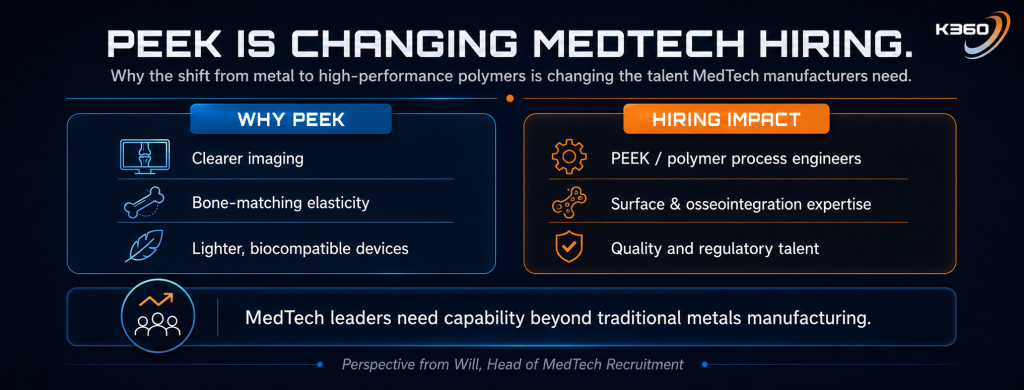
One is imaging. PEEK is radiolucent, meaning it does not create the same imaging interference associated with metallic implants. Depending on the application, this can help clinicians view the area surrounding an implant and monitor healing more clearly.
Its mechanical properties are also attracting attention. Materials specialists point to PEEK having an elasticity closer to cortical bone than many traditional implant metals. This may support more natural load transfer and help address concerns around stress shielding, where a much stiffer implant carries a disproportionate amount of the load.
There are practical advantages too, including lower weight than many metal alternatives, chemical resistance and compatibility with a range of sterilisation environments.
These characteristics explain why PEEK is gaining attention. But from a hiring perspective, the important point is that it is not simply a like-for-like material substitution.
PEEK Is Not a Simple Material Swap
A manufacturer cannot necessarily take a component historically produced from titanium or stainless steel, manufacture the same design from PEEK and assume everything else will remain unchanged.
The material behaves differently. Its manufacturing processes, controls and risks may also be different.
New questions can emerge around:
- Machining parameters and thermal management
- Additive manufacturing or forming processes
- Tooling, fixturing and dimensional stability
- Surface condition and implant architecture
- Cleaning and sterilisation
- Inspection and production consistency
- Process validation and regulatory documentation
This creates a capability challenge before it creates a recruitment challenge.
A company with a strong metals background may already possess excellent knowledge of precision machining, inspection, quality, validation and regulated manufacturing. All of that remains valuable.
However, introducing PEEK or another high-performance polymer may require additional knowledge that does not currently exist within the team.
The key word is additional.
The future is unlikely to involve replacing an established workforce. It is more likely to require combining existing medical device manufacturing expertise with new polymer, process and surface technology capabilities.
That sounds straightforward until you try to hire for it.
Osseointegration Makes the Hiring Brief More Complicated
Osseointegration is one of the clearest examples of why recruiting “someone who knows PEEK” may not be enough.
PEEK is generally regarded as bioinert, meaning the base material does not naturally encourage bone attachment in every application. This has driven innovation beyond the material itself and into areas including surface modification, coatings, porosity and implant architecture.
Invibio has discussed approaches including titanium coatings, surface porosity and hydroxyapatite.
Meanwhile, Evonik and Curiteva have worked together on porous, additively manufactured PEEK structures for spinal implant applications.
From a recruitment perspective, this is where the challenge becomes obvious.
Who owns that problem?
Does it sit with a Materials Engineer, R&D Engineer or Surface Engineer? Is it the responsibility of an Additive Manufacturing Engineer, a Manufacturing Engineer scaling the process or the Quality Engineer validating it?
In reality, it may cross several of these functions.
That is why companies need to be careful about attempting to solve a new materials challenge using one conventional job description.
The Biggest Risk Is Hiring New Capability Through Old Job Titles
Companies often recognise that they have a technical problem before they understand exactly who they need to solve it.
A business may advertise for a CNC Manufacturing Engineer when it really needs someone who has taken high-performance polymer components into validated medical production.
It may search for a Materials Engineer when the requirement actually crosses polymers, implant manufacturing, surface technology and design transfer.
It may recruit another Quality Engineer without defining whether that person needs experience with material changes, cleaning validation, sterilisation, biocompatibility or process qualification.
Before opening a vacancy, manufacturers should ask:
What are we trying to manufacture? Where is the greatest technical risk? Which capabilities already exist internally? What knowledge currently sits with a supplier? Where does the process struggle between R&D and production? What experience would genuinely shorten the route into repeatable manufacturing?
Those answers should shape the hiring brief — not the job title used by a competitor.
What I Would Look for in Candidates
When supporting a company moving further into PEEK or other advanced polymers, I would look beyond whether a candidate has the right company names on their CV.
I would want to understand:
- Whether they have personally worked with PEEK, PAEK or comparable high-performance polymers
- Where they operated in the product lifecycle: development, design transfer, scale-up or established production
- Whether they owned the technical process or relied heavily on supplier expertise
- How closely they worked with quality, regulatory and manufacturing teams
- Whether they supported cleaning, sterilisation, biocompatibility or process validation
- Which manufacturing problems they encountered and how they resolved them
Plenty of candidates have worked for a company that used an advanced material.
Far fewer can explain the problems encountered when attempting to manufacture it consistently, validate the process and transfer it into production.
That is the experience I would be trying to uncover.
The PEEK Talent Pool May Be Wider Than You Think
The right candidate may not be sitting inside your closest competitor.
Some will come directly from orthopaedics, spine, dental, cranio-maxillofacial or other implant manufacturers. Others may be working within specialist polymer machining companies, medical device contract manufacturers, advanced material suppliers, coatings businesses or additive manufacturing teams.
A search built entirely around five direct competitors may feel safe, but it can exclude people who have already solved a very similar manufacturing problem in a different environment.
The challenge is identifying which experience is genuinely transferable.
That is where specialist MedTech recruitment should add value: not by sending more CVs, but by understanding the capability gap well enough to know where else to look.
The Material May Change the Device, but People Get It to Market
PEEK is not replacing metal across medical device manufacturing, and nobody serious in the industry is suggesting that it will.
Where manufacturers do select it, however, the decision can affect design, manufacturing, suppliers, validation, quality, regulatory strategy and the route into production.
Every one of those eventually becomes a people question.
Because the material may change the device. The people will determine whether it reaches the market.
Kensington360 supports medical device manufacturers with specialist recruitment across engineering, R&D, manufacturing, quality, regulatory, commercial and leadership functions.
To discuss an emerging capability gap or a difficult MedTech appointment, explore our MedTech recruitment services or email Will Hollis.
Frequently Asked Questions
Is PEEK replacing metal in medical devices?
No. Titanium, stainless steel, cobalt-chrome and other metals remain essential across medical device manufacturing. PEEK is an alternative for selected applications where characteristics such as radiolucency, weight, chemical resistance or material stiffness offer an advantage.
What skills are needed for PEEK medical device manufacturing?
Requirements vary by product, but employers may need experience spanning high-performance polymers, precision machining, additive manufacturing, design transfer, surface engineering, cleaning, sterilisation, process validation, quality and regulatory compliance.
Where can manufacturers find candidates with PEEK experience?
Relevant candidates may come from implant manufacturers, polymer machining specialists, medical device contract manufacturers, advanced material suppliers, additive manufacturing companies, coatings businesses and other highly regulated industries.
Image alt text: Materialise personalised PEEK cranio-maxillofacial implant displayed on a skull model
Image caption: Materialise’s new personalised PEEK CMF implant. Image credit: Materialise.